
Request an Appointment
Please let us know your details and we will be in touch to confirm a booking for you.


Does the Type of Therapy Matter? | Takoma Park Therapy
Monday, September 28, 2026

All articles
Does the Type of Therapy Matter? | Takoma Park Therapy
There are many paths to healing. The relationship you build with your therapist helps you find a way forward that fits you.
CBT. DBT. EMDR. ACT. IFS.
When you start looking for a therapist, the number of unfamiliar terms can make choosing someone feel overwhelming. Each approach offers a different way of understanding what you are experiencing and what might help.
There are many paths to healing. Research has consistently found that the relationship between the therapist and the client is one of the strongest predictors of whether therapy will be helpful.
The approach provides direction and structure. The relationship is the foundation on which change is built. A good therapist-client relationship makes doing the hard work of therapy easier to manage. (note - I did not say therapy is easy!)
Why is the relationship with your therapist important?
A helpful therapeutic relationship develops when you feel heard, taken seriously, and supported in the process of therapy.
Over time, you and your therapist should develop a shared understanding of what brought you to therapy, what you hope will change, and how you work best together. Each relationship is unique, and you should never feel like a number.
The application of a specific technique improves when you trust your therapist and understand what you are doing and why. The quality of the relationship can influence how comfortable you feel being honest, raising concerns, and exploring difficult experiences.
Does the type of therapy still matter?
Some forms of therapy focus on thoughts and behaviors. Others explore relationships, earlier experiences, emotions, physical sensations, or the meaning you have made of what has happened to you.
One path may suit you better than another. Your needs may also change during therapy. You might begin by needing practical ways to manage anxiety and later want to understand the experiences and relationship patterns beneath it.
A good therapist brings knowledge and training to this process while continuing to pay attention to you. They notice what helps, listen when something does not feel useful, and adjust the work as you learn more about what you need.
For certain concerns, specialized training can be particularly important. Someone seeking treatment for substance use issues, for example, usually benefits from a therapist trained in addictions. Someone hoping to process trauma should work with a therapist with experience using trauma-focused approaches.
What might therapy look like?
Every therapy session and every relationship is unique to you and your therapist. Many Takoma Therapy clinicians use more than one approach. They draw from different parts of their training depending on what you are experiencing and what seems helpful. A useful starting point is to think about what you want from your sessions.
If you are looking for practical strategies
Some people want help identifying patterns and learning specific ways to respond differently. Your therapist may help you look at how your thoughts, emotions, and actions affect one another. You might practice skills for coping with anxiety, managing strong emotions, setting boundaries, or making changes in your daily life.
Cognitive Behavioral Therapy, Acceptance and Commitment Therapy, Dialectical Behavior Therapy, Motivational Interviewing, and Solution-Focused Therapy can all be used in this kind of work.
See below for a list of Takoma Therapy clinicians who use practical and skills-based approaches.
If you want to understand patterns in your life and relationships
Perhaps you keep finding yourself in similar relationships, or you know that earlier experiences continue to influence how you see yourself. You may want time to understand where those patterns came from and how they are affecting your life now.
Psychodynamic, relational, attachment-based, and emotion-focused approaches can support this exploration. Sessions may include thinking about your family, your past, the ways you learned to protect yourself, and the meaning you have made of your experiences.
See below for a list of Takoma Therapy clinicians who use practical and Life and Relationship approaches.
If you want help processing trauma
Trauma therapy includes several different approaches. A therapist might use EMDR, Cognitive Processing Therapy, Narrative Therapy, Internal Family Systems, mindfulness, or another trauma-informed method.
Good trauma therapy helps you understand how you adapted to what happened, strengthen your ability to manage what comes up, and approach difficult experiences at a pace you can tolerate. Your therapist should talk with you about the approach they recommend and help you prepare before beginning deeper trauma work.
See below for a list of Takoma Therapy clinicians who take a trauma-informed approach to therapy.
If you want to work with emotions the body or creativity
Some experiences are difficult to explain in words. You may understand something intellectually and still feel its effects strongly in your body.
Therapists who work in this way may bring in mindfulness, breathing, movement, physical sensations, art, imagery, or other forms of expression. These methods can help you notice what is happening internally and find additional ways to express or respond to it.
See below for a list of Takoma Therapy clinicians who use emotions, bodywork, or creative approaches to therapy.
These are a few examples of the approaches available at Takoma Therapy. Many of our therapists work across several of these categories, and their profiles provide more information about their experience and style.
How do I choose the right therapist in Takoma Park, Silver Spring, or DC?
There are many ways to do good therapy. Finding the right therapist means finding someone with the knowledge and experience to help with your concerns, and with whom you can develop enough trust to do the work together.
You can begin with what you are carrying, what you would like to understand, and what you hope might change. Our Intake Coordinator can use that information, along with practical considerations such as availability, insurance, and whether you prefer in-person or virtual sessions, to help you identify a potential match.
Takoma Therapy provides in-person therapy at our Takoma Park office, convenient to Silver Spring and Northwest Washington, DC. Virtual appointments are also available for clients in Maryland and DC.
Our free Guide to Choosing Your Takoma Therapist explains what to look for, how to think about fit, and what to consider during your first few sessions.
You can also explore our therapist profiles or contact our Intake Coordinator at intake@takomatherapy.com. We can help you find a therapist who may be a good companion for the path ahead.
Frequently asked questions
What types of therapy are available at Takoma Therapy?
Our therapists use approaches including CBT, ACT, DBT, psychodynamic and relational therapy, EMDR, Internal Family Systems, Narrative Therapy, mindfulness, somatic practices, and expressive arts. Many integrate several approaches based on each client's needs.
Does Takoma Therapy offer in-person and virtual therapy near Silver Spring and DC?
Yes. Our office is in Takoma Park, near Silver Spring and the Washington, DC border. Virtual therapy is also available for clients in Maryland and DC.
Can Takoma Therapy help me choose a therapist?
Yes. Our Intake Coordinator can consider your concerns, schedule, insurance, session format, and the qualities that may help you feel comfortable with a therapist.
Find a therapist by the kind of support you want
Many therapists draw from several approaches and could fit into more than one of these groups. We have placed each therapist under one category to make the list easier to use. Their individual profiles provide more information about their training, experience and therapeutic style.
You want practical strategies
These therapists may be a good place to begin if you want concrete tools, coping strategies or help making changes in your daily life.
- Ne’Sha Hall, LMSW
- Renee Wang, LMSW
- Brandon Brumskill, LCPC
- Anna Ehrlich, LCSW-C
- Mackenzie Speir Carter, LMSW
- Nicole Ziesing, LMSW
- Priscilla Barnes, LCPC
You want to understand patterns in your life and relationships
These therapists may be a good fit if you want to understand how earlier experiences, relationships, beliefs or recurring patterns affect your life now.
- Elana Rombro, LMSW
- Katie Kaufmann, LMSW
- Audrey Schreiber, LMSW
- Bonnie Hough, LMSW
- Mark Hollingshead, LCPC
- Lincoln Pratt, LMSW
- Tanisha Sanders, LCSW-C
- Simone Jacobs, LCSW-C, LICSW
You want help processing trauma
These therapists have experience with trauma-focused work. Their approaches vary, so you may want to read their profiles to learn more about their particular training and style.
- Stephan Solat, LCSW-C
- Hannah Bricker, LICSW
- Stephen Mann, LCPC
- Kimberley Ince, LCPC
- Casi Leisure, LGPC
- Jessica Jenkins, LCSW-C, LICSW
- Chelsea Turner, LCSW-C, LICSW
You want to work with emotions, the body, or creativity
These clinicians may be a good fit if you are interested in emotional exploration, mindfulness, movement, breath, body awareness or creative expression.
- Elena Palermo, LMSW
- Polly Matthews, LMSW
- Noah Hughes-Dunn, LGSW
- Vishal Narang, LGPC
- Jared Giles, LMSW
- Janet Svirsky, LMSW, LGSW
- Alex Phelan, C-IAYT, E-RYT 500
You do not have to choose on your own
These categories offer a starting point, but they cannot capture everything a therapist brings to their work. Many of our therapists use more than one approach and adjust their work according to the needs of each client.
If this feels overwhelming, or you don’t know where to start, our Intake Coordinator is here to help. They can help you consider what brings you to therapy, the kind of support you want, your schedule, your insurance and whether you prefer in-person or virtual sessions.
You can read our Guide to Choosing Your Takoma Therapist, explore our therapist profiles, or contact us at intake@takomatherapy.com.
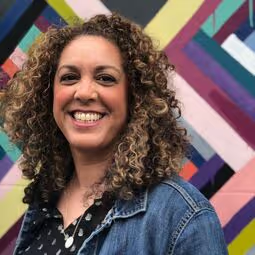
Simone Jacobs, LCSW-C, LICSW (she/her/hers)
I truly enjoy engaging with people and have a naturally warm, open style. I believe my authenticity and compassion are key to forming trusting relationships with my clients. To me, therapy is about having a conversation with you. I listen to the stories you share about your life and look for the meaning you have given to those stories. I ask questions that explore the relationship you have with yourself, those around you, and how the experiences you share about yourself shape those relationships. I ask questions that seek out alternate perspectives that highlight your ability to handle whatever difficulty you may be facing. Together we can work towards creative resolutions to complex issues.
For nearly 20 years I've focused my work on individuals, couples, and families dealing with trauma as a result of abuse and neglect. My experience as a trauma counselor also fuels my passion to help women of color explore issues of racism, sexism, and intergenerational healing. As a biracial, female therapist I am uniquely effective at being able to look through the lens of racial identity questions with my clients.
I hold a Bachelor of Science degree from Kings College, London University, and a Master's in Social Work from Smith College. I am a member of the International Society for the Study of Trauma and Dissociation. For many years, I was a presenter at the ISSTD Conference, speaking on the topic of surviving childhood trauma. Much of my work outside of the practice now focuses on the link between the legacy of slavery and mental health.
My first book, “Understanding the Paradox of Surviving Childhood Trauma: Techniques and Tools for Working with Suicidality and Dissociation", is available from Amazon, or through Routledge Publishing. Written for trauma therapists, although anyone can read it, it provides a fresh lens through which to view the coping mechanisms of survivors of childhood abuse and neglect.
Speaking Engagements
For speaking engagements, clinical presentations, and business-related inquiries, please contact Simone Jacobs at simonejacobs@takomatherapy.com.
Who is Takoma Therapy?
Takoma Therapy is a local practice based on the Takoma Park / DC border, offering warm, thoughtful support for individuals and couples, both in-person and online.
- Easy to access from DC, Silver Spring, and nearby areas
- We help you find the right therapist, not just any therapist
- A space where you feel understood, not judged
- Clear, supportive help navigating insurance and getting started
More from the blog



.png)






Follow us on Instagram


© Copyright 2026
Takoma Therapy LLC
All Rights Reserved
