
Request an Appointment
Please let us know your details and we will be in touch to confirm a booking for you.


Building Your At-Home Self-Care Kit
Wednesday, May 27, 2026

All articles
Building Your At-Home Self-Care Kit
You made it through the day. You held it together in the meeting, kept your voice steady in the hard conversation, managed the commute, got through the door. And now the mask comes off.
Home is where you get to stop performing. It's where the feelings you've been carrying finally have room. And sometimes it can feel like the weight of the whole day lands on you the moment you sit down.
But home is also an opportunity. More than anywhere else, it's where you can practice self-care in a deeper, slower, more intentional way. You have space here. You have privacy. You have time. An at-home self-care kit gives you a specific place to turn when hard feelings come, and a place to learn how best to support yourself regardless.
This post is about how to build one.
A Corner/Box/Room That's Yours
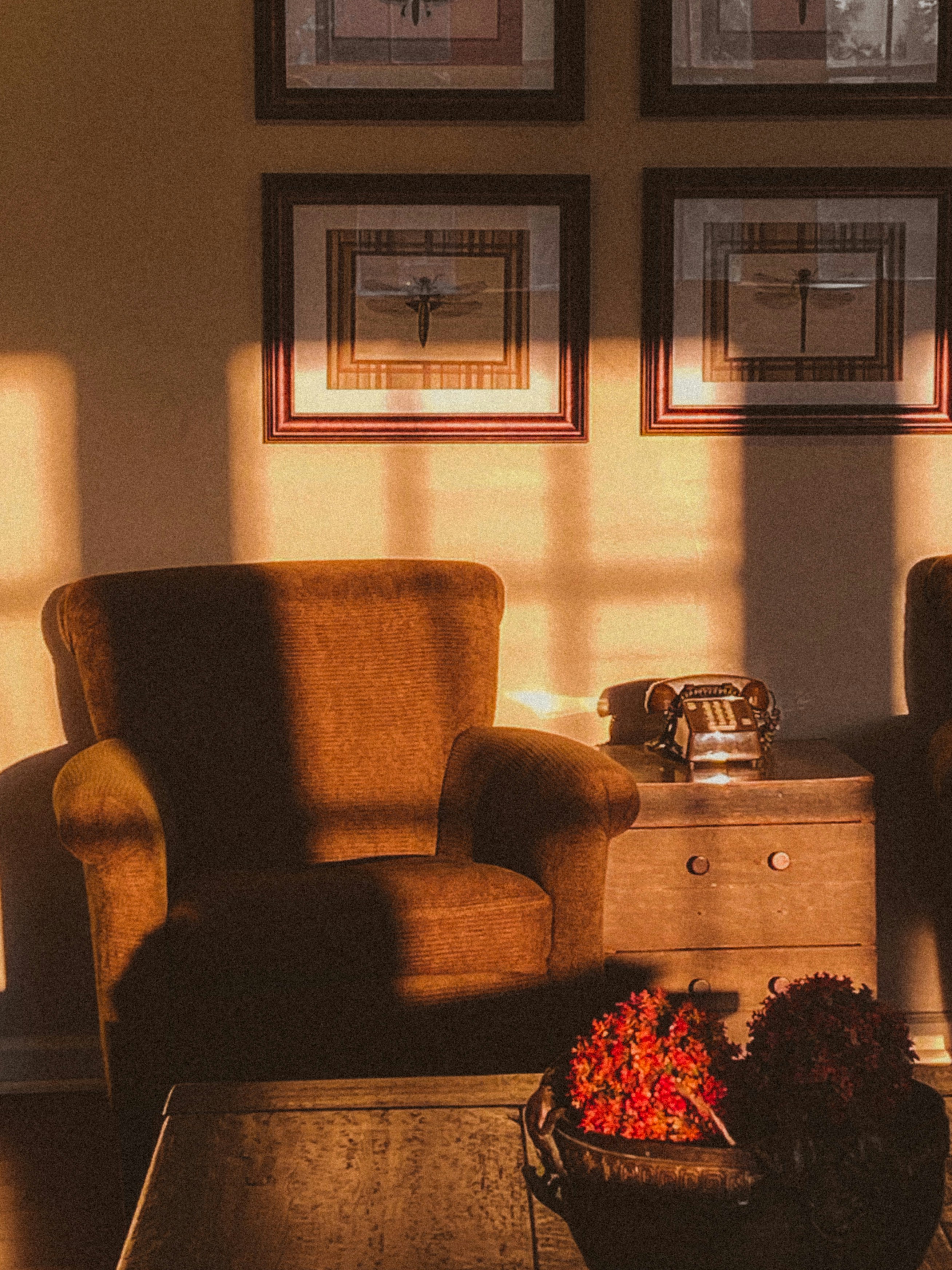
If you can, set aside a small physical space in your home just for this. A chair, a shelf, a corner of your bedroom, the end of a couch, even a small shoe box will work. You need somewhere that belongs to this work.
Having a physical space matters because it signals something to your brain: this is where I care for myself. You start to associate the space with safety, the way it associates your bed with sleep.
Inside that space, keep a box, basket, or shelf with a few categories of things.
What to Include
Books and written comfort: a gratitude journal, a book of poetry, a favorite novel you can pick up anywhere, a therapy workbook you're slowly working through.
Creative tools: sketchbooks, colored pencils, paints, clay, knitting, a collage kit, a coloring book. Something that engages your hands when your head is too full. Using your hands is a great way to regulate, or distract yourself.
Cultural and spiritual items: incense, prayer beads, a candle, an object from your family or culture, a text that grounds you. Whatever reminds you that you belong to something larger than this hard moment.
Sensory comfort: a soft blanket, warm socks, a weighted blanket, cushions, a candle, an eye mask, essential oils. Things that tell your body it's safe.
Nature: a small plant you can water, a few pressed flowers, a jar of shells, photographs of places that calm you. A tangible reminder that the world is bigger than this room.
Movement and release: a yoga mat, a foam roller, a stretching band, a small massage tool. Something to move the feeling through your body so it can pass.
Think of this list as a menu and choose two or three things from two or three categories to begin. Start with what you already have. The kit evolves. What you need in January might shift by June. One day you sit down and know exactly what you want to do but another day it may take 3 or 4 tries to figure out what’s really needed.
Using Your Kit
Sometimes you need to create something. Sometimes you need to be soothed and comforted. Having an array of options lets you choose the kind of care that matches what the moment is asking for.
Some days you will know exactly what you want from this space. A blanket and a book. The yoga mat and a long exhale. Other days you will stand in front of it and feel flat. That is the nature of care. Hard feelings sometimes resolve slowly, and self-care sometimes takes a while to feel soothing. On those days, the point is simply to sit with yourself, even awkwardly, and show your nervous system that you are willing to show up.
If building a kit feels like one more thing to add to an already full life, that feeling makes sense. Earlier in this series we talked about how self-care can trigger its own kind of resistance, and how starting very small is often the most honest place to begin. One item. One shelf. One quiet moment. The kit is not a project to finish. It is a relationship you are slowly building with yourself.
Try using your kit when you're calm. Read there. Drink coffee there. Let it become a place you return to often, so your brain recognizes it as safe well before you need it in a hard moment.
If you share your home, tell the people you live with what this space is for. Children and teens can have their own versions.Naming this space as care, openly and without apology, helps everyone around you understand what you're doing.
A Final Reflection
Whether you are building this kit from scratch or gathering a few things that already feel like comfort, the work is the same. You are building internal resources. You are teaching your body that hard feelings are survivable. You are giving yourself something to reach for.
This is not about adding more to your plate. It is about slowly changing your relationship with yourself, so that care becomes something you return to naturally rather than something you have to force. That is what this whole series has been pointing toward. Not a perfect routine, not a finished kit, but a practice that grows alongside you.
Therapy is where a lot of that learning happens. A kit is what carries the learning into the rest of your life.
You can use these tools in hard moments, and you can use them in ordinary ones to build joy, self-awareness, and connection. Over time, you will learn what works best for you, and your kit can grow and change with you.
If you're in the Takoma Park, Silver Spring, Washington DC, or Maryland area and ready to build new ways of responding to hard emotions, Takoma Therapy offers trauma-informed, mindfulness-based therapy for individuals, adolescents, and children. We work with people navigating anxiety, burnout, stress, and the deeper patterns that make caring for yourself feel out of reach. Contact us today to learn more.

Simone Jacobs, LCSW-C, LICSW (she/her/hers)
I truly enjoy engaging with people and have a naturally warm, open style. I believe my authenticity and compassion are key to forming trusting relationships with my clients. To me, therapy is about having a conversation with you. I listen to the stories you share about your life and look for the meaning you have given to those stories. I ask questions that explore the relationship you have with yourself, those around you, and how the experiences you share about yourself shape those relationships. I ask questions that seek out alternate perspectives that highlight your ability to handle whatever difficulty you may be facing. Together we can work towards creative resolutions to complex issues.
For nearly 20 years I've focused my work on individuals, couples, and families dealing with trauma as a result of abuse and neglect. My experience as a trauma counselor also fuels my passion to help women of color explore issues of racism, sexism, and intergenerational healing. As a biracial, female therapist I am uniquely effective at being able to look through the lens of racial identity questions with my clients.
I hold a Bachelor of Science degree from Kings College, London University, and a Master's in Social Work from Smith College. I am a member of the International Society for the Study of Trauma and Dissociation. For many years, I was a presenter at the ISSTD Conference, speaking on the topic of surviving childhood trauma. Much of my work outside of the practice now focuses on the link between the legacy of slavery and mental health.
My first book, “Understanding the Paradox of Surviving Childhood Trauma: Techniques and Tools for Working with Suicidality and Dissociation", is available from Amazon, or through Routledge Publishing. Written for trauma therapists, although anyone can read it, it provides a fresh lens through which to view the coping mechanisms of survivors of childhood abuse and neglect.
Speaking Engagements
For speaking engagements, clinical presentations, and business-related inquiries, please contact Simone Jacobs at simonejacobs@takomatherapy.com.
Who is Takoma Therapy?
Takoma Therapy is a local practice based on the Takoma Park / DC border, offering warm, thoughtful support for individuals and couples, both in-person and online.
- Easy to access from DC, Silver Spring, and nearby areas
- We help you find the right therapist, not just any therapist
- A space where you feel understood, not judged
- Clear, supportive help navigating insurance and getting started
More from the blog



.png)




Follow us on Instagram


© Copyright 2026
Takoma Therapy LLC
All Rights Reserved
