
Request an Appointment
Please let us know your details and we will be in touch to confirm a booking for you.


How Do I Know If I Need Therapy?
Tuesday, August 4, 2026

All articles
How Do I Know If I Need Therapy?
Part of our Understanding Therapy series, answering the questions people ask before they ever schedule a session.
A short answer: you might benefit from therapy if you're asking questions about your patterns, relationships, or reactions that are hard to answer on your own, whether or not anything in your life is currently in crisis.
In the past, people didn't have therapy as an option in the way we do now, and relied much more heavily on families, close friends, mentors, faith communities, and neighbors for guidance, support, and a sense of belonging. Those relationships carried much of what we now bring into therapy. Today, therapy exists alongside them, not as a replacement, but as an additional resource when those supports are limited, strained, or not enough on their own.
Even the closest relationships can't always answer every question on their own, or catch the patterns that are hardest to see from the inside. That's where therapy can help.
Therapy Offers a Different Kind of Perspective
Therapists are trained to notice patterns, ask thoughtful questions, and offer a perspective that isn't caught up in the rest of your life the way the people close to you are. A good friend might remind you of your strengths when you've forgotten them. A therapist helps you understand why you keep doubting yourself in the first place. A family member might encourage you to leave an unhealthy relationship. A therapist helps you understand what keeps pulling you back.
You Don't Have to Be in Crisis
Many people assume therapy is only for moments when life is falling apart, and sometimes that's true. People often turn to therapy while navigating things like:
- Trouble sleeping, or feeling tired no matter how much rest you get
- A racing mind, or a sense of being constantly on edge
- Grief, loss, or a major life transition
- A low mood or a loss of interest in things you used to enjoy
- Difficulty concentrating or following through on things
Just as often, people begin therapy because they feel stuck. They find themselves wondering:
- Why do I keep ending up in the same kinds of relationships?
- Why do I react so strongly in certain situations?
- Why do I know what I want to change but can't seem to change it?
- Why do I feel like I've lost touch with myself?
- Why do I keep having the same arguments or making the same choices?
You don't need to have all the answers before starting therapy, being curious is enough.
What Therapy Actually Does
Therapy helps you make sense of your inner life, whether or not something is urgently wrong. As you start to recognize patterns in your thoughts, emotions, relationships, and experiences, you often discover new ways of responding to life's challenges. Change becomes less about forcing yourself to be different and more about understanding yourself with greater clarity and compassion. So instead of asking whether you need therapy, ask the question underneath:
What would change if I finally understood why I keep doing this?
Therapy is a good place to start looking for the answer.
At Takoma Therapy, we see therapy as a space to better understand yourself, make sense of your experiences, and move toward the life you want to live.
Starting is often easier than people expect. At Takoma Therapy, serving Takoma Park and the greater DC metro area, we're in-network with CareFirst Blue Cross Blue Shield, Aetna, and some Cigna plans, so therapy can be more accessible than you might think. If you're curious whether it's the right fit for you, reach out and we can talk through what getting started would look like. And if you're ready to look for a therapist, here's how to choose the right one.
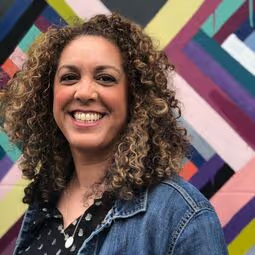
Simone Jacobs, LCSW-C, LICSW (she/her/hers)
I truly enjoy engaging with people and have a naturally warm, open style. I believe my authenticity and compassion are key to forming trusting relationships with my clients. To me, therapy is about having a conversation with you. I listen to the stories you share about your life and look for the meaning you have given to those stories. I ask questions that explore the relationship you have with yourself, those around you, and how the experiences you share about yourself shape those relationships. I ask questions that seek out alternative perspectives that highlight your ability to handle whatever difficulty you may be facing. Together we can work towards creative resolutions to complex issues.
For over ten years I've focused my work on individuals, couples, and families dealing with trauma as a result of abuse and neglect. My experience as a trauma counselor also fuels my passion to help women of color explore issues of racism, sexism, and intergenerational trauma. As a biracial, female therapist I am uniquely effective at being able to look through the lens of racial identity questions with my clients. In 2013, I established Takoma Therapy’s ‘Women of Color’ Group for this purpose, and remain committed to this program.
I hold a Bachelor of Science degree from Kings College, London University, and a Master's in Social Work from Smith College. I am a member of the International Society for the Study of Trauma and Dissociation. For many years, I was a presenter at the ISSTD Conference, speaking on the topic of surviving childhood trauma. Much of my work outside of the practice now focuses on the link between the legacy of slavery and mental health.
My first book, “Understanding the Paradox of Surviving Childhood Trauma: Techniques and Tools for Working with Suicidality and Dissociation", is available from Amazon, or through Routledge Publishing. Written for trauma therapists, although anyone can read it, it provides a fresh lens through which to view the coping mechanisms of survivors of childhood abuse and neglect.
Speaking Engagements
For speaking engagements, clinical presentations, and business-related inquiries, please contact Simone Jacobs at simonejacobs@takomatherapy.com.
Who is Takoma Therapy?
Takoma Therapy is a local practice based on the Takoma Park / DC border, offering warm, thoughtful support for individuals and couples, both in-person and online.
- Easy to access from DC, Silver Spring, and nearby areas
- We help you find the right therapist, not just any therapist
- A space where you feel understood, not judged
- Clear, supportive help navigating insurance and getting started
More from the blog











Follow us on Instagram


© Copyright 2026
Takoma Therapy LLC
All Rights Reserved
