
Request an Appointment
Please let us know your details and we will be in touch to confirm a booking for you.


Part 3 - What to Expect in Your First Few Sessions
Monday, July 7, 2025

All articles
Part 3 - What to Expect in Your First Few Sessions
Choosing a Therapist: What to Look For and Why It Matters
Part 3 - What to Expect in Your First Few Sessions
Part 3 of the “Choosing a Therapist” Series
This blog is part of our “Choosing a Therapist” series, created to help you take your first steps toward therapy with more clarity and confidence. At Takoma Therapy, we want our clients to feel empowered in the therapy process. That begins by thinking about what kind of therapy and what kind of therapist might be helpful to you. What works well for one person might feel completely off for someone else. There’s no one-size-fits-all. If you’d like to skip ahead or keep a copy for yourself, you can download the full guide [here]. No email required.
The First Sessions Are About Fit, Not Perfection
When Tariq walked into his first session, he wasn’t sure what to expect. He had gone back and forth for months before booking. He worried that he might say the wrong thing or that the therapist would stare at him in silence. Instead, what surprised him most was the relief he felt after just being able to say, “I don’t know what I need, but I know I need something.”
Your first few therapy sessions are not about spilling your life story all at once. They are about feeling out the connection and starting to understand if this person feels like someone you can build trust with over time. It’s okay if it takes a few tries to get there.
How We Do Things at Takoma Therapy
At Takoma Therapy, we use a thoughtful three-session assessment process. Instead of rushing into treatment goals right away, we take time to get to know you. That means:
- Listening to your story without pressure
- Exploring what brings you in and what you want to get out of therapy
- Making space for you to notice how you feel in the room with your therapist
- Reflecting together on whether this feels like a good fit
You won’t be locked into anything. We see these sessions as a conversation. If you decide we’re not the right practice for you, we’ll do our best to help you find someone who is.
What Happens in These Sessions?
While every therapist brings their own style, here’s what you can generally expect:
Session 1: You’ll talk about what brought you to therapy. This might include current stressors, big life events, or lingering emotional patterns. The therapist will ask questions, but there’s no test to pass. It’s just a starting point.
Session 2: The conversation goes a bit deeper. Your therapist may ask about family, past experiences, or relationships. You’ll begin to explore how the past and present connect.
Session 3: You and your therapist reflect on the process so far. How did the space feel? What felt helpful, or not? From there, you’ll decide together whether to move forward or explore other options.
Questions to Reflect On
As you go through these sessions, keep a few questions in mind:
- Do I feel comfortable talking to this person?
- Am I able to speak freely, even about difficult things?
- Do I feel heard and taken seriously?
- Is the therapist explaining things in a way that makes sense to me?
- Do I feel hopeful that this could help, even if it’s hard?
There’s no pressure to feel certain right away. But you should have a sense that this space could grow into something meaningful.
Up Next: Common Concerns About Starting Therapy
In Part 4, we’ll talk about the doubts and worries that come up for many people starting therapy. Things like, “What if I don’t click with my therapist?” or “What if therapy makes me feel worse before I feel better?” These are valid concerns, and you deserve honest answers.
Until then, you can download the full Choosing a Therapist Guide [here], explore our team [here], or reach out to intake@takomatherapy.com if you’re ready to talk with someone directly.
Your first session doesn’t have to be perfect. It just has to be yours. We’re here to support you through it.
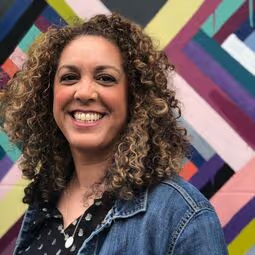
Simone Jacobs, LCSW-C, LICSW (she/her/hers)
I truly enjoy engaging with people and have a naturally warm, open style. I believe my authenticity and compassion are key to forming trusting relationships with my clients. To me, therapy is about having a conversation with you. I listen to the stories you share about your life and look for the meaning you have given to those stories. I ask questions that explore the relationship you have with yourself, those around you, and how the experiences you share about yourself shape those relationships. I ask questions that seek out alternate perspectives that highlight your ability to handle whatever difficulty you may be facing. Together we can work towards creative resolutions to complex issues.
For nearly 20 years I've focused my work on individuals, couples, and families dealing with trauma as a result of abuse and neglect. My experience as a trauma counselor also fuels my passion to help women of color explore issues of racism, sexism, and intergenerational healing. As a biracial, female therapist I am uniquely effective at being able to look through the lens of racial identity questions with my clients.
I hold a Bachelor of Science degree from Kings College, London University, and a Master's in Social Work from Smith College. I am a member of the International Society for the Study of Trauma and Dissociation. For many years, I was a presenter at the ISSTD Conference, speaking on the topic of surviving childhood trauma. Much of my work outside of the practice now focuses on the link between the legacy of slavery and mental health.
My first book, “Understanding the Paradox of Surviving Childhood Trauma: Techniques and Tools for Working with Suicidality and Dissociation", is available from Amazon, or through Routledge Publishing. Written for trauma therapists, although anyone can read it, it provides a fresh lens through which to view the coping mechanisms of survivors of childhood abuse and neglect.
Speaking Engagements
For speaking engagements, clinical presentations, and business-related inquiries, please contact Simone Jacobs at simonejacobs@takomatherapy.com.
Who is Takoma Therapy?
Takoma Therapy is a local practice based on the Takoma Park / DC border, offering warm, thoughtful support for individuals and couples, both in-person and online.
- Easy to access from DC, Silver Spring, and nearby areas
- We help you find the right therapist, not just any therapist
- A space where you feel understood, not judged
- Clear, supportive help navigating insurance and getting started
More from the blog










Follow us on Instagram


© Copyright 2026
Takoma Therapy LLC
All Rights Reserved
